.

Friday, June 5, 2015

Can we Predict Disasters and SHTF events?


An essential part of the preparedness problematic is how unpredictable disasters and emergencies are by their own nature. If we always knew what was going to go wrong, when and where, the incident could then be prevented or avoided entirely. The unpredictability is a key element of a disaster. This may lead us to believe that there’s no way of knowing when disaster will strike.
This isn’t entirely true. Although it sure isn’t an exact science, to a significant extent we can predict within a certain margin of error most of these disruptive events. Some may be more predictable than others, and you can’t hope for much accuracy regarding timeframes, but detailed risk assessment goes a long way in knowing what we’re likely to deal with in the future.
The problem many preppers and survivalists encounter is, yet again, the lack of objective, reality-based research and analysis. Popular beliefs among the prepper community, most of them fueled by nothing more than romantic fantasies, are brought to the discussion as if they were unquestionable facts written in stone even though they may be completely fabricated. The simple truth is that a lot of the objective analysis isn’t very entertaining, and the conclusions to where they lead are even less so.

Don’t bother owning more than one gun for defense, you’re unlikely to ever need to use even one, needing two for self-defense in the civilian world is statistically impossible. Don’t live in some beautiful place surrounded by nature, practically all research shows that you’ll live a healthier and happier lives living in a condo, hitting the gym three times a week and working hard on your career. That doesn’t sound very adventurous, does it? Well, many times preparing isn’t supposed to be fun.
It is right at this point where I’ll happily be the first one to point out the obvious: There’s more to life than surviving. It’s about living YOUR life after all, living it YOUR way. If you love living by the ocean because you love sailing or living surrounded by thousands of acres of forest because you love the outdoors, then that’s what you should do. The trick is, be honest with yourself, don’t lie to yourself about what you want, what you need and the reasons for doing what you do in an attempt to justify your decisions. Not everything has to be logical and functional, not everything requires a practical use that justifies your decisions. If you can accept this, then your decisions will be much wiser. If we reach this point of honesty with ourselves then we can start looking at things from a new perspective and understand better the challenges we are likely to face.
If we are interested in the study of survival, then the first thing we want to avoid is dying. Simple enough, isn’t it? Ask yourself, what are the leading causes of death? 2 seconds of googling will show you the following:

Heart disease: 611,105
Cancer: 584,881
Chronic lower respiratory diseases: 149,205
Accidents (unintentional injuries): 130,557
Stroke (cerebrovascular diseases): 128,978
Alzheimer's disease: 84,767
Diabetes: 75,578
Influenza and Pneumonia: 56,979
Nephritis, nephrotic syndrome, and nephrosis: 47,112
Intentional self-harm (suicide): 41,149
http://www.cdc.gov/nchs/fastats/leading-causes-of-death.htm

Out of the ten most common causes of death, other than the 4th one (which we’ll get to in a second) are directly linked to having a healthy body and mind, a sound diet and a good level of fitness. Surprisingly enough very few of these are ever discussed in most preparedness discussions. Why? Because watching your diet, not overeating and eating more vegetables isn’t as much fun as talking about zombies, raiders and the end of the world. From a practical approach to survivalism though, it is much more effective.
When it comes to the 4th top cause of death, accidental injury related deaths, the truth doesn’t align with the popular belief of avoiding cities being the better option. Why Cities Are Safer Than Rural Areas: 5 Surprising Facts
Not dying is a good start, but for step number two we also want to have a healthy life worth living. Notice how by tackling the main causes of death we are also addressing the main causes of sickness, which considerably improves your quality of life while alive. As if that wasn’t enough, staying healthy and in shape boosts your morale and overall sense of joy. Here we may want to pay particular attention to the mental or emotional aspect of health: Avoiding depression, having a good marriage and family relationship, enjoying the kind of work you do. Emotional health is as important as the physical one.

Ok, so we’re not dying, which is a good start, and we’re not getting sick physically or mentally. Things are already looking good! But what about good old Murphy showing up and spoiling our little personal utopia? What ruins life for people, what concerns us the most? Which are the threats we are likely to face? This is the third step, the one where we go past the first two unavoidable facts of life (dying and getting sick) which have a probability of 100% on the long run, and we start doing a dedicated risk assessment based on our location and lifestyle. In general, this is the one most preppers and survivalist jump right into, completely overlooking the all-important first two. “oh, here’s where my CCW comes into play and saves me from all the thugs on the streets..” Actually, no. Hold your horses. Lets take a look at the leading causes of injury-related deaths:
1 Suicide
2 Motor vehicle crashes
3 Poisoning
4 Falls
5 Homicide
http://www.webmd.com/mental-health/news/20120920/suicide-top-cause-of-injury-death

Turns out, chances are that you’re more likely to end up killing yourself than getting shot by some street thug. Clearly we can’t emphasize enough how important mental health is.
Not being much of a surprise, car accidents are a leading cause of death. Its safe to say chances of getting involved in a car crash are pretty high during our lifetimes. What can we do about it? Here’s where the intelligent survivalist goes to work. You drive carefully, that should be obvious enough. But you also buy a vehicle with a high safety and survivability score. You keep your car serviced. You make sure your tires are in good shape. You never drink and drive. You try not to drive during nighttime and you avoid driving during storms. These alone will highly improve your odds for one of the most common causes of injury related death.
While some children do die of unintentional poisoning (very careful with that!) “Poisoning” also seems to be today’s politically correct way of saying death due to drug overdose. Again, working on emotional health and strong family bonds is essential.
Falls are a common form of injury, especially among the elder population. How likely? 1 in 3 of the elder population +65 fall each year. By the time they reach 80, 1 out of 2 will fall at least once a year. http://www.learnnottofall.com/content/fall-facts/how-often.jsp
The falls often causes fractures, which may lead to more serious conditions or even death. Understanding how likely this is to happen helps towards planning for it better. Have proper footwear and walking aid when required. Consider moving with someone else so as to not be alone or keep your cellphone with you in case you fall. Be particularly careful with ice and wet floors.

When it comes to homicide, avoiding dangerous places and having means of self-defense will obviously help. USA has a homicide rate average of 4.7 per 100.000 population. While this isn’t something to lose sleep over, it makes sense to have means of self-defense and avoid dangerous places as much as possible. In high-crime areas, the greater risk calls for other measures such as better safety habits and improved home security. The higher the crime rate, the less forgiving the environment will tend to be.

Natural disasters are also predictable to a great extent. Events such as earthquakes, tornados, floods and storms, they tend to occur in specific areas where they have happened before. While this doesn’t make them completely predictable, it does mean that they are very likely to occur again and that you should prepare for them.
Many times man-made disasters can be detected as well before they occur. On a macroeconomic level we see signs such as inflation, unemployment and institutional instability as signs of possible economic problems and civil unrest. Geopolitical tensions may be a prelude to open hostilities between nations. Staying informed is key to detecting potential problems on the horizon.
When preparedness is approached through a logical, educated, common sense process, we can foresee some of the most likely disasters and emergency situations.
FerFAL
Fernando “FerFAL” Aguirre is the author of “The Modern Survival Manual: Surviving the Economic Collapse” and “Bugging Out and Relocating: When Staying is not an Option”.

Wednesday, June 3, 2015

14500 vs AA: Are 14500 the prefect EDC light battery?


For many years I used a 1XCR123A light of some kind or another as my EDC light. 4Sevens, Fenix, lately Eagletac D25C. I like how bright they are but I don’t like how those batteries aren’t nearly as common as AA or AAA. From a survivalist perspective, commonality and availability is an important factor. You never know when you’ll need to improvise or make do with whatever you come across… and you’re far more likely to come across AA and AAA than R123As. Still, given the different modes flashlights have these days and that they can go for days at a time on moonlight mode I was still ok with that. Keep an eye on the batteries, replace when needed and don’t wait until they are completely dead.
The thing is, with LED technology getting better every year, I started carrying around 1xAA EDC lights, lately the Thrunite T10T, which is a nice, sleek titanium light. At 169 lumens its bright enough but I found myself missing the extra power of the Lithium batteries. After a bit of reading around in candlepowerforum and checking that the T10T could take it, I went ahead and got a couple 14500 lithium ion batteries (basically the same form factor as AA, but in li-ion).
Man! Those are nice. You visible get more lumens out of it (about 250 lumens), its rechargable so you dont waste money on batteries and if needed you can go ahead and use common AA found everywhere.
This works great for EDC since you can give a quick charge every few weeks to keep your 14500 in good shape. Maximum brightness, no more dead batteries all of a sudden, making it an ideal solution for having both brightness and battery commonality. Best of both worlds kind of situation.


Here you have a comparion of two 1xAA lights, Sunwayman Dolphin C15A on the left with a AA Duracel Primary, and the Thrunite T10T with a 14500 TrustFire on the right. When using Duracel AA, both are about the same brightness, so here you can clearly see the difference.


FerFAL
Fernando “FerFAL” Aguirre is the author of “The Modern Survival Manual: Surviving the Economic Collapse” and “Bugging Out and Relocating: When Staying is not an Option”.

Monday, June 1, 2015

GPS Phone tracker for Family members


Don Williams said...
It's somewhat Orwellian but GPS beacons will let you track your child's location if he is kidnapped. Some of the products let you define a geo-fence and sends you a cell phone alert if the kid wanders outside the defined area (e.g., his school's boundaries)

http://www.friendshipcircle.org/blog/2014/01/15/7-tracking-devices-to-find-a-lost-child-with-autism/

http://www.gpsmagazine.com/2008/05/the_ultimate_gps_child_trackin.php

The SPOT Satellite Personal Tracker is used by Big Kids also. Uplinks distress calls to satellites overhead. If you go hiking in the Amazon and annoy the natives it will help your family find your remains.

And some of these devices have been used by suspicious wifes to track where hubby's car goes after work. heh heh

Hint: Spy shops sell a scanner to locate such a beacon on your car -- the CIA's Clandestine Service are amateurs conpared to some philandering husbands.

http://www.spyguysecurity.com/collections/bug-detectors/products/vm-3-gps-tracker-detector
 .
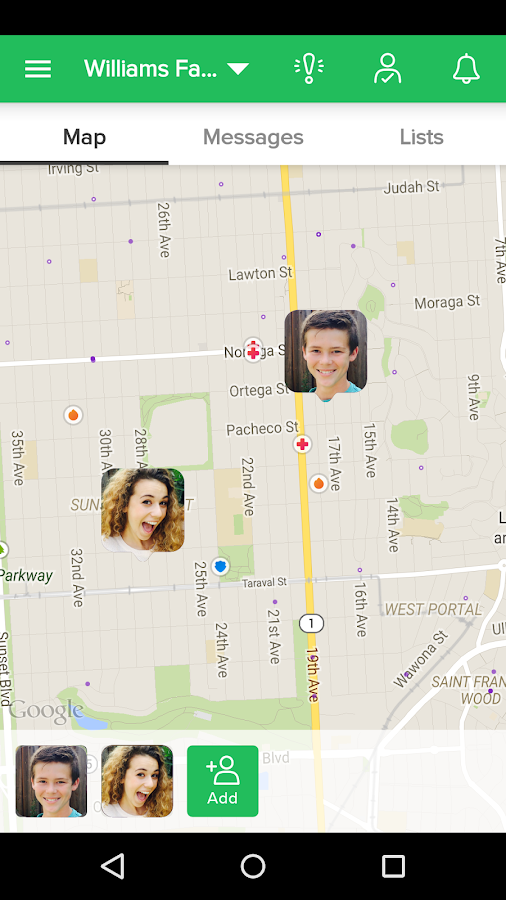
I recommend downloading the App GPS Phone Tracker Pro for all family members.
GPS Phone Tracker Pro - screenshot
Yes, it is kind of creepy but then again it does work and we do use it in my family.
Sometimes my oldest son comes back with some smartass remark about his rights. My reply usually goes along the lines “oh, you though this was a democracy.. I see the confusion. Its not. Think of it as a benevolent dictatorship where you do as I say”. All joking aside, it makes perfect sense to have the GPS turned on and know where your loved ones are at all times. It gives you a lot of peace of mind and during an emergency its much easier to know everyone’s whereabouts.
The NSA is already spying on all of us and that won’t change any time soon. Each family member knowing where everyone else is, that we consider an asset rather than an intrusion.
FerFAL
Fernando “FerFAL” Aguirre is the author of “The Modern Survival Manual: Surviving the Economic Collapse” and “Bugging Out and Relocating: When Staying is not an Option”.

Reply:"Jade Helm 15: Police militarization and troops deployed on American soil"

Anonymous said...
I believe that Jade Helm is just another military training event. By next September no one will have anything to say about it because nothing will have happened as a result of it. If I'm wrong and they somehow manage to put all 330 million of us into FEMA camps then I will admit I'm wrong. But I would bet dollars to doughnuts that all the scare mongers will refuse to admit they were wrong if nothing happens.
May 29, 2015 at 6:38 PM
Delete
Blogger Blackeagle said...
"At the most minimum level, what concerns me the is that the United States has both laws and traditions where utilizing civilian areas for drills and training exercises isn't really cool."

This is simply untrue. The U.S. Special Operations community has been training in civilian areas for many decades. The Robin Sage exercise that serves as the culmination of the Special Forces Qualification Course has been held in central North Carolina for over 40 years. While Robin Sage is the best known, there are many other, smaller, training exercises happening on a pretty much continuous basis. This sort of thing is neither new nor exceptional.
May 29, 2015 at 8:43 PM
Delete

Friday, May 29, 2015

Jade Helm 15: Police militarization and troops deployed on American soil

http://static6.businessinsider.com/image/53ed367f6bb3f789681f4229-1200-1000/sniper-ferg.jpg
Hi Fernando,

I was very touched that you wrote back to me and also published my email on your blog.  

I've also really enjoyed your analysis of the survival situation in Ukraine, especially breaking apart the finer points and details about how even wearing the wrong color jacket or shoes can signal a person out for interrogation and possibly death and how to manage the cell phone situation.

I have a question for you; there is a wide scale military "drill" thats been making news here in the US called Jade Helm 15.  

I wonder if you would be willing to give us some of your thoughts on this, and/or realistic "preps" for the various scenarios people think might happen? 


Some people are extremely concerned that its not a drill, and will be an integration of widespread martial law, possibly coinciding with a financial crisis. 

Other people think its a drill that is meant to habituate the US population to martial law, and others think its exactly what the official statement says it is; a training exercise to help our forces prepare for on-the-ground situations in foreign nations.

At the most minimum level, what concerns me the is that the United States has both laws and traditions where utilizing civilian areas for drills and training exercises isn't really cool.  

In the U.S we have, or used to have, a very clear distinction between military and civilian law enforcement, and we even have a separate thing called the National Guard so that when something happens that is too big for local law enforcement or disaster services to handle (like riots, or a big tornado), we have the necessary support and specialized equipment to deal with those situations without utilizing the military.   The guys who set up this country initially were pretty darn smart and wanted to do everything possible to ensure that our military was never used on our against our own citizens or on our land, as they knew how easily that turns into a coup. 


All the best,

Angela
.
Hi Angela,
You address several interesting topics.
About police militarization, I do believe it has been going on for far too long and in the last decade or so (more like last two decades) it has gotten a lot worse.
It’s not just police using military clothing, but also military weapons and military tactics. It was disgraceful to see military-grade snipers sitting on top of armored vehicles taking aim at the (peaceful) protesters through their rifle’s scope. Exactly what were they supposed to do now? Attack the population with “sniper” fire?

Many current officers have served in the military, the distinction between military and civilian is already complicated enough. When you have guys that are already more soldier than cops, you dress them up as soldiers, give them soldier weapons and talk to them like soldiers, organize them like soldiers, and even put them inside armored vehicles, it’s not hard to see how they will act.
https://johntoconnell.files.wordpress.com/2014/08/20140814_ferguson_police.jpg

Now, some people may think this is good, that more “firepower” stops crime better and keeps streets safer. No, it does not. The role of a police officer is completely different from the one of a soldier. If you end up with “peace officers” that for all practical purposes are soldiers rather than cops, then you no longer have a democracy. We need to go back to having police, not troops with a “police” Velcro stuck on their body armor.
Regarding Jade Helm 15, I think there’s a bit of conspiracy theory going on but there’s some truth to some of the claims as well. It is true that people do get used to it if they see troops on the street on regular basis, which is something the military is interested in because it will reduce the friction with civilian society when deployed on domestic ground. It is also true that drills are intended as practice, and if they are practicing locally it would help if troops need to be deployed on US soil. Is it all precisely in preparation of riots after a potential economic collapse? Maybe, but then again, it is also valid in case of deployment due to a number of other potential reasons.

As of right now, I think its important to a)Keep law enforcement within its role, don’t’ allow its militarization under any excuse, don’t let cops turn into soldiers 2) Not allow the same the other way around, don’t let troops patrol, secure the streets, and basically do the job intended for police officers.
FerFAL