.

Wednesday, April 13, 2016

Know your Rescue Signals


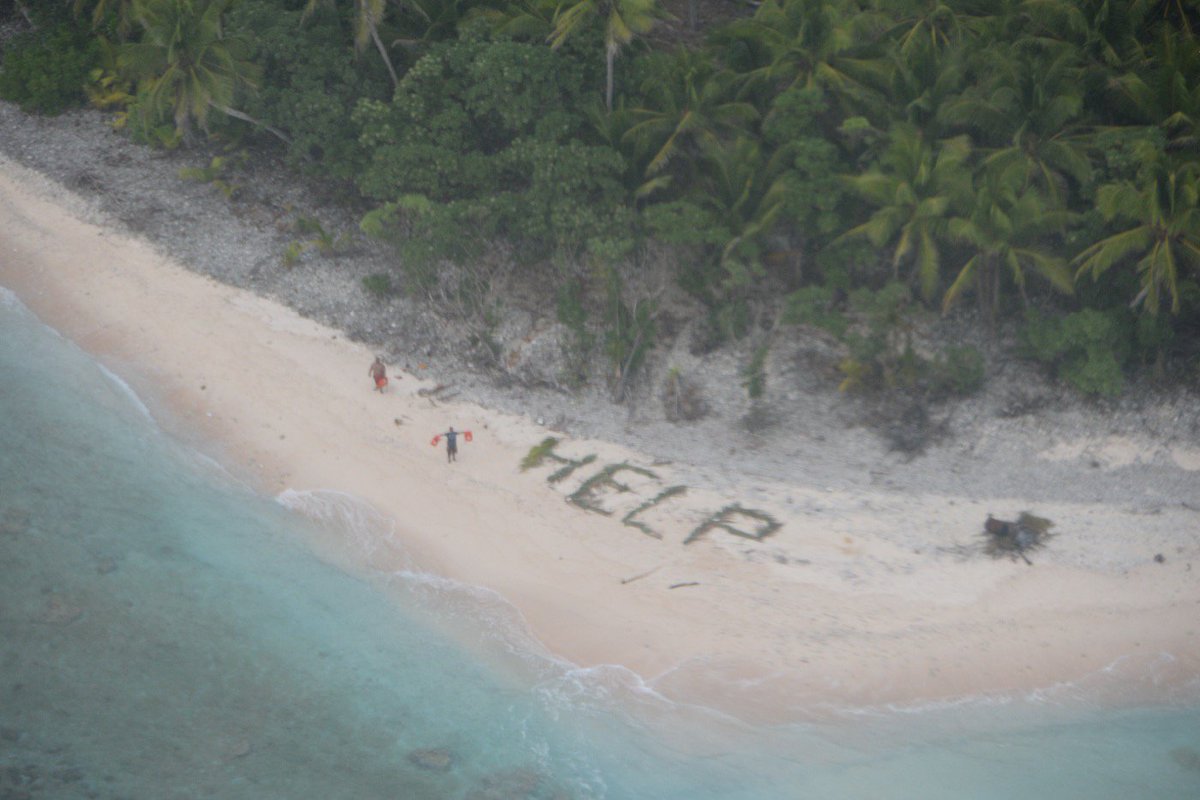
Three men were rescued from the tiny Pacific Island of Fanadik by a U.S. Navy plane that had spotted their H-E-L-P sign.
Do you know your signals? Try remembering at least these two. “V” means you require assistance. Maybe more noticeable from the air is the international “SOS”.  It’s also easier and requires less material than writing “HELP”. Most people know what SOS means (save our souls) and is less likely to be overlooked or confused with random debris than “V”. Also, try remembering the arrow signal. This can be very important if you decide to move away from the area so that search and rescue teams know the direction you took.

One final tip. During night time, a triangle of three fires is an international distress signal. This can done with three fires with about 100 feet between them, maybe using three flares or flashlights.
FerFAL
Fernando “FerFAL” Aguirre is the author of “The Modern Survival Manual: Surviving the Economic Collapse” and “Bugging Out and Relocating: When Staying is not an Option”.

Monday, April 11, 2016

Survival Supplies: What do refugees need?

https://nantiareport.files.wordpress.com/2016/03/wp-1457699152121.jpg
(The following post has been contributed by Greekman. Thanks for the information shared!
Check his website at https://survivalcomms.wordpress.com/
-FerFAL)
The point of studying the needed items is that the refugee situation in Greece is very alike an earthquake –or any large scale disaster- leaving thousands of people helpless.
It also speaks of the Greek state organization and preparedness level, but this isanother subject.
ΑΠΕ-ΜΠΕ/ΝΙΚΟΣ ΑΡΒΑΝΙΤΙΔΗΣ
check more images http://www.lifo.gr/now/greece/92341
Items requested by the NGOs and volunteers for the refugee camps
First of all there were many things needed for infants and kids:
Baby food, Diapers, Strollers, Baby bottles, Feeding Bottle Sterilizer, Toys and Balls, Baby Clothes and Shoes.
Hygiene items were also asked. No need to mention anything specific, they need everything, but of note was that some asked for empty soap dispensers.
Comment: That makes the point of being able to setup a number of faucets on a 6-foot length of pipeline.
Among what the refugees were assign for was to take a bath to feel decent.
In this video an older couple allowed them to take showers in their home https://www.youtube.com/watch?v=rfRwyzAcYHY
The same need for everything applies to Shelter and Bedding items, and one-use eating utensils. Regarding Blankets the Ngo were providing them with one and told them to keep them for the duration of their travel.
Regarding food, some items that were usually required were:
Condensed/Evaporated Milk, Sugar & Crackers, Snacks, Tea, Raisins, Cookies, Rusks, Nuts, Honey, Jams, and Tomato Paste.
Comment: I guess their large supplies were of basic staple foods with not much of the rest, especially breakfast items.
Then there are some noteworthy items either often required or were unexpected to see.
Rain ponchos and Wood (related to the bad weather conditions during the winter/early spring)
Bananas (seems they are a very good nutrition supplement)
Cell Chargers and Extension cords.
Drawing and Coloring items and also Balloons (the kids were overjoyed with that humble toy)
https://blogger.googleusercontent.com/img/b/R29vZ2xl/AVvXsEijgusWFsu74-Sv5XzYjNKUEewA9rU-OvPmMe-R489AvmgdapHMUzQvwxz_oKULmfsutiZL-xKSrJVdiD3Glopeoe-GnyAWw2rmbRSlO7-3bKystFrzaizywNhZO6fRo6WjYVtPF-n-QxaR/s1600/DSC06002.JPG
The refugees also looked for free Wifi Access to connect home and browse for info.
Comment: While a lot of facebook pages and less often blogs were set up for the collection of items. I haven’t yet heard of any blog dedicated to the refugees needs and information.
I think it would be a good idea for a relief/volunteer team to prepare a blog ahead of time and fill it with info and links to reliable sources on the ground.
Lastly, and believe it or not, the refugees would benefit from some basic survival and bushcrafting instruction by knowledgeable people on the spot. Amassed on farm fields in Idomeni, their tents would get full of water when it rained since no one knew that they would have to make a draining ditch.
Medicines
Eye Drops
Nasal Decongestion Sprays
Throat lozenges
Bronchodilators (Albuterol)
Steri-Strips
Tongue Depressors
Syringes (5 & 10ml)
Betadine
Paracetamol (and Cold & Flu and Cold & Cough versions)
Natural Tears
Sterile Irrigating Solution
Vitamin A Supplements
Anti-Diarrheal Drugs
Antihistaminic Creams
Baby Rash creams (zinc-oxide)
Hydrocortisone Creams
NSAID Ointments
NSAIDs
Antiemetics (Anti vomit action)
Antacid Tablets
Urinary Infections Antibiotics
Antibiotic Impregnated Gauzes
Sunburn Treatment
Ferfal there were some more drugs that I cannot know what their type is called
Buscopan – Butylscopolamine
http://www.drugs.com/international/butylscopolamine.html
Bepanthen-Panthenol
https://en.wikipedia.org/wiki/Panthenol
The medicine list is a good guide for those that want to keep a stock o emergency/disaster/preparedness medications at home.
…
Note from FerFAL:
Thanks Greekman. At the end of the day its people that have nothing and well, its pretty much the same thing everywhere. After years of studying disasters and unfortunately having seen more than enough first hand, I can say its not people that are different but it’s their circumstances that dictate certain differences. Other than that, everyone needs the same things.
For example, no matter where in the world disaster strikes leaving thousands with nothing, they are all looking for: A home, or at least a safe dry and warm place to rest. Clean clothes, diapers, food for adults, babies and children, toiletries, sanitation supplies, diapers, medicine. Then you have location specific items, like warm clothes for cold climates, sunscreen or mosquito repellent. Most of all, poor and displaced people have something in common: They are both looking for JOBS.
FerFAL
Fernando “FerFAL” Aguirre is the author of “The Modern Survival Manual: Surviving the Economic Collapse” and “Bugging Out and Relocating: When Staying is not an Option”.

Thursday, April 7, 2016

Survival... Rolex?


Hi Fernando,
Whats your experience with rolex watch?  Will it hold value in SHTF?  Decrease, increase?
 
If I remember correctly, you mention in your first book, but I am traveling and do not have it with me to look up what you said about it.
 
I have some savings which I am using to purchase precious metal coins. However, in one of the shops, I came across a (genuine) 18k gold ladies oyster perpetual president made in the early 80's for US $3,800 and it got me to thinking.
 
1) It is my understanding is that I could walk into any major city in the world and be able to convert it easily into cash.
 
In your experience, would that be accurate?
 
I am always on the go---traveling somewhere---both around the US and international.  I like the concept of a rolex because its subtle.  It is seen as a personal item and would never get counted towards the $10K cash limit.
 
Since it is an older model, if anyone ever asks about it, I will say it belonged to my grandmother and was passed down to me.
 
We have problems now in the US with police officers confiscating (stealing) your cash and monetary instruments claiming its suspicious for "drugs" even if you have committed no crime and have never touched a single drug in your life.
 
As opposed to bullion, it is highly unlikely that a rolex worn on your wrist would ever be confiscated by police or customs.
 
Other questions/concerns:
 
2) The scrap value of the gold in the watch is only about US $1200 compared to its asking price of $3,800.  In terms of holding its value, is it better to stick to bullion coins? Or would it be reasonable to expect that a genuine gold Rolex would hold/increase its value in bad times?  
 
3)  I am a single female and usually solo.  How much danger am I putting myself in by having and wearing a gold rolex? 
 
I am automatically on "yellow" alert whenever in public, and practice situational awareness at a level much higher than most.
 
For the time being, I'm sticking to "1st world" countries, although who knows? That could change.
 
I have done a lot of internet research about this model of watch and the price. Retail price for the same or similar watch in the US right now is between $7,000-$12,000.  This caused me to be suspicious of the seller, so I went back and examined the watch closely with gem magnifier, and it is definitely authentic.
 
I asked the shop owner why this piece is priced so low.  He said that most of the merchandise are things he purchased and re-sells.  But that this particular piece he is doing on consignment for a friend and she needs the $$.
 
He confirmed everything I had researched online about how, in the USA, this watch would sell for $7,000 +;
 
He said that here in Canada (quebec), there just aren't many buyers for rolex because Canadians don't have money like Americans do.  And that most of his rolex customers are actually Americans who come over the border to make purchases.
 
 
Thank you so much for everything you do!  Love your stuff, and Im just bummed that I didnt bring your book with me!
 
 
Angela
...
Hello Angela,
In most countries that I’ve been to form USA to Argentina and here in Europe, the advertising seems to be the same: “We buy your gold, silver, diamonds and Rolex”.
You have to keep it mind though that the selling price is nothing like the buying price. In general you are lucky to get half of what a potential customer is willing to pay once the dealer flips the watch. Now if you can get it yourself for such a low price then you could probably sell it elsewhere without losing money or maybe even making some on top.
In general yes, Rolex do hold their value pretty well, same as quality jewellery. The trick is knowing your trade, knowing how to avoid counterfeit items, and of course avoiding the ridiculously low offers you come across sometimes and sticking to serious people.
I was talking with a jeweller today and he was showing me how to grade diamonds, which imperfections are acceptable and which are not. Its all very interesting stuff. Again, the selling price is often not as good as the buying one so you do lose some, but Rolex watches hold on nicely. The nice thing about bullion is that market price is fixed so there’s less room for excuses. Try talking with the shop owner. Ask him, honestly, how much would be pay for a similar item if he was buying so as to get a reasonable profit margin himself. That will give you somewhat of an idea of how much you can get for it.
So, answering your questions.
1)Yes, in most city centers around the world you will be able to sell your Rolex for good money. Some dealers may haggle worse than others but you will walk out with a wad of cash. The trick is buying a quality item, paying as little for it as possible and then asking around to get a good deal when it’s time to sell.
2)For protecting money, I think precious metals is the way to go because as I said before, it has a given market price and there isn’t much to debate about. Pure gold is just that. Watches, antiques and even numismatic coins have a certain value as well and they may well be good investments and ways of moving around a lot of cash. I doubt the average TSA agent knows what a Mercury Dime 1916 D is, but the thing is worth $135,000 in  MS67 condition. Having said that, its not as reliable in terms of knowing the specific price as checking the daily given value of gold and silver. The same coin can be worth $100, or $100.000 depending on its grade, and the difference between Fine condition or Very Fine condition can be hard to tell. Even experts may have a difference of opinion. This kind of problem doesn’t exist with precious metals.
3)I would say the risk is pretty high. In a place like Argentina its downright suicidal. I’m not exactly a “soft target”, yet for some time I stopped wearing my gold wedding ring, replaced it for a silver one like lots of other people did back in the day. Now in first world countries this may not be that much of a problem. In most European capitals and large cities you see women with very expensive jewellery. Still, I would say a gold Rolex is pretty noticeable and pretty tempting. In moderate to high crime areas I would keep it out of sight. If you just want to keep it with you then it would just be a matter of being careful and when you know you are in more troubled areas just put it in your purse.
Stay safe!
FerFAL
Fernando “FerFAL” Aguirre is the author of “The Modern Survival Manual: Surviving the Economic Collapse” and “Bugging Out and Relocating: When Staying is not an Option”.

Monday, April 4, 2016

Shooting Video: 5 important Street Survival Lessons

Just a few days ago this happened in down town Buenos Aires.

After attempting to rob a man that had just left the bank with a significant amount of cash, two criminals take off in a motorcycle as the man draws a Glock and shoots five or six times, killing an innocent bystander, a locksmith that was just walking by.
  • Laws change from one country to another, even from one state to another. Keeping that in mind, it is still safe to say that in most jurisdictions its practically impossible to claim self-defense when shooting someone clearly escaping from you. Again, different laws, but in general you don’t want to shoot a bad guy in the back as he moves away from you.
  • Elemental rule of firearms safety: Know your backstop. A gunfight is a very dynamic situation, but still you should maintain a level of self-control and avoid opening fire in areas full of innocent bystanders in the line of fire.
  • This incident happened in the financial district of Buenos Aires. Notice how just seconds after dropping practically dead everyone just keeps walking around him as if a dead guy on the sidewalk was the most normal thing in the world. The normalcy bias is a strong psychological safety mechanism.
  • Today there are cameras everywhere, even without them shootings leave plenty of evidence around, from ballistics to blood splatter patterns, it is fairly easy to tell who got shot in what circumstance.
  • Many of the bystanders attempted to do the right thing in this type of situation: When you hear gunfire, take cover! The two on top drop to one knee or lower their bodies although it would have been much better to go prone, the one on the right attempts to get behind the wall of a building entrance, but fails to do so fully which would have been much better. Oh, and one more thing. It is estimated that half the motorcycles in the down town area with two people are driven by criminals. There’s even been laws proposing to ban more than one person in them in the capital.
FerFAL
Fernando “FerFAL” Aguirre is the author of “The Modern Survival Manual: Surviving the Economic Collapse” and “Bugging Out and Relocating: When Staying is not an Option”.

Friday, April 1, 2016

5 Most Common Fails in your BOB/Survival Kit