
 Posts
Posts


CapnRick said...
Nice read, guys! Thanks for these thought provoking posts. We need to keep sharing this stuff.
These posts show the preview of what will ultimately be the result in those areas of the USA where class warfare (the elite left against the middle class) is allowed to flourish.
The progressives take steps to bankrupt the economy because they know that the resulting fear and guilt will put them in power to force their view of a unified government control... meanwhile, enriching themselves and their commercial stooges. Then, they use the labor unions and radical organizations to control the schools and universities, indoctrinate the young, bring the media and what's left of the financial system under government control. The government becomes the dominant employer, continues to stir up class warfare and continues to drain the treasury to keep the fear level of economic hardship/survival high so that their bold steps to rush through their agenda will be allowed. As Rahm Emmanuel said..."never let a good crisis go to waste", as exemplified by this administration spending more money in 8 months than the entire expenditure of the US government in history. They were allowed to do it due to fear of financial meltdown, enabling the administration to GUARANTEE financial meltdown for their own benefit. Those who are aware of the recent history of Argentina, Venezuela, Russia and Zimbabwe understand what is happening in California.
Those states who already have a state income tax, who tax food items, who have bankrupted their state to benefit welfare issues like California and Arizona are the first to fall... because, when the revenue dries up, there are no additional sources of funds. States such as Texas and Florida have these additional forms of revenue to tap if needed. One may wonder if the states that have their economies under control may decide if they want to continue to share their wealth with Washington, DC or not.
El Chavez and the Ks have this routine down pat, and look at the US slide towards government control with big grins of satisfaction. What they are overlooking is the power of online journalists to bring illegal government activity to the attention of our strong criminal justice/judicial systems... something that AR and VZ haven't had in so long that they are no longer aware of the existance of such a system.
We still lock up politicians currently in power, while VZ and AR await the next bunch of crooks to be in power before bringing politicians to justice.
Ron Paul's flat tax looks like a good idea to consider, but, I don't see any national-level support.
Keep up the good work, guys. -CapnRick
.

Sunday, October 4, 2009
CapnRick's Reply: California (not) dreaming


California (not) dreaming
Fernando,
Got your book and learned a lot from it. Thanks. Recommended it to all my friends (the smart ones saw the wisdom in getting it, the grasshoppers did not).
Have you seen this article (http://www.guardian.co.uk/world/2009/oct/04/california-failing-state-debt) from the UK Guardian about California becoming a failed state? It seems that much you wrote about in Argentina is playing out in California.
James P
Hi! I just read it, thanks a lot.
Very interesting and please everyone, take the time to read it.
Not the kind of collapse you’d think of, but ask those folks over at that Forum if life as they once knew it ended or not.
When our economy collapsed in 2001 we had poverty of over 50% and unemployment of 20-25%. I think those numbers are a good milestone to keep in mind, I doubt a modern society can hold together with those percentages. Unfortunately, California is moving towards that.
Also notice some of the text I marked. Some parts are very similar to what happened here, what people said.
Again, do read it and notice the black letter parts. Those are the kind of things you could expect to see in other states as well if things keep getting worse, typical of the crisis. Notice the comments I added as well, some of these things I mentioned a few years ag, reffering to our situation here in Argentina after the 1a1 collapse.
FerFAL
Will California become America's first failed state?
http://www.guardian.co.uk/world/2009/oct/04/california-failing-state-debt
By Paul Harris
* The Observer, Sunday 4 October 2009
* Article history
Los Angeles, 2009: California may be the eighth largest economy in the world, but its state staff are being paid in IOUs, unemployment is at its highest in 70 years, and teachers are on hunger strike (edited by FerFAL: For years we had the teachers on strike. The Carpa Blanca of teh teachers, protesting in front of Congress). So what has gone so catastrophically wrong?
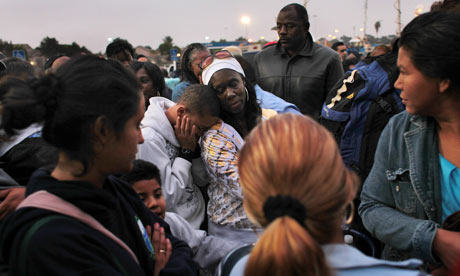
Patients without medical insurance wait for treatment in the Forum, a music arena in Inglewood, Los Angeles. The 1,500 free places were filled by 4am. Photograph: John Moore/Getty Images
Patients without medical insurance wait for treatment in the Forum, a music arena in Inglewood, Los Angeles. The 1,500 free places were filled by 4am. Photograph: John Moore/Getty Images
California has a special place in the American psyche. It is the Golden State: a playground of the rich and famous with perfect weather. It symbolises a lifestyle of sunshine, swimming pools and the Hollywood dream factory.
But the state that was once held up as the epitome of the boundless opportunities of America has collapsed. From its politics to its economy to its environment and way of life, California is like a patient on life support. At the start of summer the state government was so deeply in debt that it began to issue IOUs instead of wages. Its unemployment rate has soared to more than 12%, the highest figure in 70 years. Desperate to pay off a crippling budget deficit, California is slashing spending in education and healthcare, laying off vast numbers of workers and forcing others to take unpaid leave. In a state made up of sprawling suburbs the collapse of the housing bubble has impoverished millions and kicked tens of thousands of families out of their homes. Its political system is locked in paralysis and the two-term rule of former movie star Arnold Schwarzenegger is seen as a disaster – his approval ratings having sunk to levels that would make George W Bush blush. The crisis is so deep that Professor Kenneth Starr, who has written an acclaimed history of the state, recently declared: "California is on the verge of becoming the first failed state in America."
Outside the Forum in Inglewood, near downtown Los Angeles, California has already failed. The scene is reminiscent of the fallout from Hurricane Katrina, as crowds of impoverished citizens stand or lie aimlessly on the hot tarmac of the centre's car park. It is 10am, and most have already been here for hours. They have come for free healthcare: a travelling medical and dental clinic has set up shop in the Forum (which usually hosts rock concerts) and thousands of the poor, the uninsured and the down-on-their-luck have driven for miles to be here.
The queue began forming at 1am. By 4am, the 1,500 spaces were already full and people were being turned away. On the floor of the Forum, root-canal surgeries are taking place. People are ferried in on cushions, hauled out of decrepit cars. Sitting propped up against a lamp post, waiting for her number to be called, is Debbie Tuua, 33. It is her birthday, but she has taken a day off work to bring her elderly parents to the Forum, and they have driven through the night to get here. They wait in a car as the heat of the day begins to rise. "It is awful for them, but what choice do we have?" Tuua says. "I have no other way to get care to them."
Yet California is currently cutting healthcare, slashing the "Healthy Families" programme that helped an estimated one million of its poorest children. Los Angeles now has a poverty rate of 20%. Other cities across the state, such as Fresno and Modesto, have jobless rates that rival Detroit's. In order to pass its state budget, California's government has had to agree to a deal that cuts billions of dollars from education and sacks 60,000 state employees. Some teachers have launched a hunger strike in protest. California's education system has become so poor so quickly that it is now effectively failing its future workforce. The percentage of 19-year-olds at college in the state dropped from 43% to 30% between 1996 and 2004, one of the highest falls ever recorded for any developed world economy. California's schools are ranked 47th out of 50 in the nation. Its government-issued bonds have been ranked just above "junk".
Some of the state's leading intellectuals believe this collapse is a disaster that will harm Californians for years to come. "It will take a while for this self-destructive behaviour to do its worst damage," says Robert Hass, a professor at Berkeley and a former US poet laureate, whose work has often been suffused with the imagery of the Californian way of life.
Now, incredibly, California, which has been a natural target for immigration throughout its history, is losing people. Between 2004 and 2008, half a million residents upped sticks and headed elsewhere. By 2010, California could lose a congressman because its population will have fallen so much – an astonishing prospect for a state that is currently the biggest single political entity in America. Neighbouring Nevada has launched a mocking campaign to entice businesses away, portraying Californian politicians as monkeys, and with a tag-line jingle that runs: "Kiss your assets goodbye!" You know you have a problem when Nevada – famed for nothing more than Las Vegas, casinos and desert – is laughing at you.
This matters, too. Much has been made globally of the problems of Ireland and Iceland. Yet California dwarfs both. It is the eighth largest economy in the world, with a population of 37 million. If it was an independent country it would be in the G8. And if it were a company, it would likely be declared bankrupt. That prospect might surprise many, but it does not come as news to Tuua, as she glances nervously into the warming sky, hoping her parents will not have to wait in the car through the heat of the day just to see a doctor. "It is so depressing. They both worked hard all their lives in this state and this is where they have ended up. It should not have to be this way," she says.
It is impossible not to be impressed by the physical presence of Arnold Schwarzenegger when he walks into a room. He may appear slightly smaller than you imagine, but he's just as powerful. This is, after all, the man who, before he was California's governor, was the Terminator and Conan the Barbarian.
But even Schwarzenegger is humbled by the scale of the crisis. At a press conference in Sacramento to announce the final passing of a state budget, which would include billions of dollars of cuts, the governor speaks in uncharacteristically pensive terms. "It is clear that we do not know yet what the future holds. We are still in troubled waters," he says quietly. He looks subdued, despite his sharp grey suit and bright pink tie.
Later, during a grilling by reporters, Schwarzenegger is asked an unusual question. As a gaggle of journalists begins to shout, one man's voice quickly silences the others. "Do you ever feel like you're watching the end of the California dream?" asks the reporter. It is clearly a personal matter for Schwarzenegger. After all, his life story has embodied it. He arrived virtually penniless from Austria, barely speaking English. He ended up a movie star, rich beyond his dreams, and finally governor, hanging Conan's prop sword in his office. Schwarzenegger answers thoughtfully and at length. He hails his own experience and ends with a passionate rallying call in his still thickly accented voice.
"There is people that sometimes suggest that the American dream, or the Californian dream, is evaporating. I think it's absolutely wrong. I think the Californian dream is as strong as ever," he says, mangling the grammar but not the sentiment.
Looking back, it is easy to see where Schwarzenegger's optimism sprung from. California has always been a special place, with its own idea of what could be achieved in life. There is no such thing as a British dream. Even within America, there is no Kansas dream or New Jersey dream. But for California the concept is natural. It has always been a place apart. It is of the American West, the destination point in a nation whose history has been marked by restless pioneers. It is the home of Hollywood, the nation's very own fantasy land. Getting on a bus or a train or a plane and heading out for California has been a regular trope in hundreds of books, movies, plays, and in the popular imagination. It has been writ large in the national psyche as free from the racial divisions of the American South and the traditions and reserve of New England. It was America's own America.
Michael Pollan, author of The Omnivore's Dilemma and now an adopted Californian, remembers arriving here from his native New England. "In New England you would have to know people for 10 years before they let you in their home," he says. "Here, when I took my son to his first play date, the mother invited me to a hot tub."
Michael Levine is a Hollywood mover and shaker, shaping PR for a stable of A-list clients that once included Michael Jackson. Levine arrived in California 32 years ago. "The concept of the Californian dream was a certain quality of life," he says. "It was experimentalism and creativity. California was a utopia."
Levine arrived at the end of the state's golden age, at a time when the dream seemed to have been transformed into reality. The 1950s and 60s had been boom-time in the American economy; jobs had been plentiful and development rapid. Unburdened by environmental concerns, Californian developers built vast suburbs beneath perpetually blue skies. Entire cities sprang from the desert, and orchards were paved over into playgrounds and shopping malls.
"They came here, they educated their kids, they had a pool and a house. That was the opportunity for a pretty broad section of society," says Joel Kotkin, an urbanist at Chapman University, in Orange County. This was what attracted immigrants in their millions, flocking to industries – especially defence and aviation – that seemed to promise jobs for life. But the newcomers were mistaken. Levine, among millions of others, does not think California is a utopia now. "California is going to take decades to fix," he says.(Edited by FerFAL: So true. These problems dont take years, they take decades to see any positive change.
So where did it all wrong?
Few places embody the collapse of California as graphically as the city of Riverside. Dubbed "The Inland Empire", it is an area in the southern part of the state where the desert has been conquered by mile upon mile of housing developments, strip malls and four-lane freeways. The tidal wave of foreclosures and repossessions that burst the state's vastly inflated property bubble first washed ashore here. "We've been hit hard by foreclosures. You can see it everywhere," says political scientist Shaun Bowler, who has lived in California for 20 years after moving here from his native England. The impact of the crisis ranges from boarded-up homes to abandoned swimming pools that have become a breeding ground for mosquitoes. Bowler's sister, visiting from England, was recently taken to hospital suffering from an infected insect bite from such a pool. "You could say she was a victim of the foreclosure crisis, too," he jokes.(Eidted by FerFAL: That's no Joke. Or at least it wont be when you start hearing the word "Dengue" several times a day. The crisis brings a new set of diseases and pandemics
But it is no laughing matter. One in four American mortgages that are "under water", meaning they are worth more than the home itself, are in California. In the Central Valley town of Merced, house prices have crashed by 70%. Two Democrat politicians have asked for their districts to be declared disaster zones, because of the poor economic conditions caused by foreclosures. In one city near Riverside, a squatter's camp of newly homeless labourers sleeping in their vehicles has grown up in a supermarket car park – the local government has provided toilets and a mobile shower. In the Los Angeles suburb of Pacoima, one in nine homeowners are now in default on their mortgage, and the local priest, the Rev John Lasseigne, has garnered national headlines – swapping saving souls to saving houses, by negotiating directly with banks on behalf of his parishioners.
For some campaigners and advocates against suburban sprawl and car culture, it has been a bitter triumph. "Let the gloating begin!" says James Kunstler, author of The Long Emergency, a warning about the high cost of the suburban lifestyle. Others see the end of the housing boom as a man-made disaster akin to a mass hysteria, but with no redemption in sight. "If California was an experiment then it was an experiment of mass irresponsibility – and that has failed," says Michael Levine.
Nowhere is the economic cost of California's crisis writ larger than in the Central Valley town of Mendota, smack in the heart of a dusty landscape of flat, endless fields of fruit and vegetables. The town, which boldly terms itself "the cantaloup capital of the world", now has an unemployment rate of 38%. That is expected to rise above 50% as the harvest ends and labourers are laid off. City officials hold food giveaways every two weeks. More than 40% of the town's people live below the poverty level. Shops have shut, restaurants have closed, drugs and alcohol abuse have become a problem.(Edited by FerFAL: So tipical. Expect this all across USA to some degree
Standing behind the counter of his DVD and grocery store, former Mendota mayor Joseph Riofrio tells me it breaks his heart to watch the town sink into the mire. His father had built the store in the 1950s and constructed a solid middle-class life around it, to raise his family. Now Riofrio has stopped selling booze in a one-man bid to curb the social problems breaking out all around him.
"It is so bad, but it has now got to the point where we are getting used to it being like this," he says. (Edited by FerFAL: MILLIONS have said those exact same words in Argentina! Riofrio knows his father's achievements could not be replicated today. The state that once promised opportunities for working men and their families now promises only desperation. "He could not do what he did again. That chance does not exist now," Riofrio says.
Outside, in a shop that Riofrio's grandfather built, groups of unemployed men play pool for 25 cents a game. Near every one of the town's liquor stores others lie slumped on the pavements, drinking their sorrows away. Mendota is fighting for survival against heavy odds. The town of 7,000 souls has seen 2,000 people leave in the past two years. But amid the crisis there are a few sparks of hope for the future. California has long been an incubator of fresh ideas, many of which spread across the country. If America emerges from its crisis a greener, more economically and politically responsible nation, it is likely that renewal will have begun here. The clues to California's salvation – and perhaps even the country as a whole – are starting to emerge.
Take Anthony "Van" Jones, a man now in the vanguard of the movement to build a future green economy, creating millions of jobs, solving environmental problems and reducing climate change at a stroke. It is a beguiling vision and one that Jones conceived in the northern Californian city of Oakland. He began political life as an anti-poverty campaigner, but gradually combined that with environmentalism, believing that greening the economy could also revitalise it and lift up the poor. He founded Green for All as an advocacy group and published a best-selling book, The Green Collar Economy. Then Obama came to power and Jones got the call from the White House. In just a few years, his ideas had spread from the streets of Oakland to White House policy papers. Jones was later ousted from his role, but his ideas remain. Green jobs are at the forefront of Obama's ideas on both the economy and the environment.
Jones believes California will once more change itself, and then change the nation. "California remains a beacon of hope… This is a new time for a new direction to grow a new society and a new economy," Jones has said.
It is already happening. California may have sprawling development and awful smog, but it leads the way in environmental issues. Arnold Schwarzenegger was seen as a leading light, taking the state far ahead of the federal government on eco-issues. The number of solar panels in the state has risen from 500 a decade ago to more than 50,000 now. California generates twice as much energy from solar power as all the other US states combined. Its own government is starting to turn on the reckless sprawl that has marked the state's development.
California's attorney-general, Jerry Brown, recently sued one county government for not paying enough attention to global warming when it came to urban planning. Even those, like Kotkin, who are sceptical about the end of suburbia, think California will develop a new model for modern living: comfortable, yes, but more modest and eco-friendly. Kotkin, who is writing an eagerly anticipated book about what America will look like in 2050, thinks much of it will still resemble the bedrock of the Californian dream: sturdy, wholesome suburbs for all – just done more responsibly. "We will still live in suburbs. You work with the society you have got. The question is how we make them more sustainable," he says.
Even the way America eats is being changed in California. Every freeway may be lined with fast-food outlets, but California is also the state of Alice Waters, the guru of the slow-food movement, who inspired Michelle Obama to plant a vegetable garden in the White House. She thinks the state is changing its values. "The crisis is bringing us back to our senses. We had adopted a fast and easy way of living, but we are moving away from that now," she says.
There is hope in politics, too. There is a growing movement to call for a constitutional convention that could redraw the way the state is governed. It could change how the state passes budgets and make the political system more open, recreating the lost middle ground. Recently, the powerful mayor of Los Angeles, Antonio Villaraigosa, signed on to the idea. Gerrymandering, too, is set to take a hit. Next year Schwarzenegger will take steps to redraw some districts to make them more competitive, breaking the stranglehold of party politics. He wants district boundaries to be drawn up by impartial judges, not politicians. In previous times that would have been the equivalent of a turkey voting for Christmas. But now the bold move is seen for what it is: a necessary step to change things. And there is no denying that innovation is something that California does well.
Even in the most deprived corners of the state there is a sense that things can still turn around. California has always been able to reinvent itself, and some of its most hardcore critics still like the idea of it having a "dream".
"I believe in California. It pains me at the moment to see it where it is, but I still believe in it," said Michael Levine.
Perhaps more surprisingly, a fellow believer is to be found in Mendota in the shape of Joseph Riofrio. His shop operates as a sort of informal meeting place for the town. People drop in to chat, to get advice, or to buy a cold soft drink to relieve the unrelenting heat outside. The people are poor, many of them out of work, often hiring a bunch of DVDs as a cheap way of passing the time.(Edited by FerFAL: Remeber what I said about TV and DVD a few years ago? Cheap (and safe) way to spend time? But Riofrio sees them as a community, one that he grew up in. He is proud of his town and determined to stick it out. "This is a good place to live," he says. "I want to be here when it turns around." He is talking of the stricken town outside. But he could be describing the whole state.★
Saturday, October 3, 2009
Want to save America? Do your own “Change”
Maybe some of you heard about Peron, maybe not.
Peronism, in the form of the political party called “Justicialismo”(Justicia means Justice in Spanish) is still the most powerful political party in Argentina, after al these years, after proving time and again it’s simply worthless.
Why? You see, Justicialismo is actually a good idea.
As politician Lilita Cario explained, Justicialismo is based on keeping a majority part of the population poor AND uneducated, made to believe that the reason for their calamities are the “rich”, and Justicialismo will fairly redistribute the wealth. Meanwhile they deal with some of the most perverse corporations in the world under the table for huge personal profit. Since the mass is uneducated, they fail to see this two faced speech Justicialismo has.
This is of course an evil and perverse system, profiting and gaining power through the misery of the people.
Hey, but it works. Works in Argentina, and with slight difference of color and flavor works in other countries as well.

 In the above picture, the sign translates to “I left Cuba to Venezuela, then from Venezuela to the United States. Where do I go from here?” (Dont like McCain, but the sign is still good)
Photos By Carlos Miller.
http://carlosmiller.com/2008/11/04/the-moment-of-truth-has-arrived-a-photo-essay/
Another powerful tool Justicialismo has and is getting used a lot these days by the K government, is that you can’t change things, you can’t defeat them.
The overall philosophy would be “Yes we are corrupt, we lie and we steal, but we are majority and we have the power so you can’t do anything”.
BS, you can always do something, but as long as most people believe nothing can be done, no one will ever try, and that’s just what they want.
But the reality is that with truth, honesty and justice on your side, you can do a great deal.
Right now the K power is shattering in Argentina, even as they pass their brutal K Media Law, that will allow full power of every media channel to the president, turning us into another Venezuela, they are already weakening. The lost the previous elections for congressmen, nad the vice president is already working with the opposition to change this dictatorial law as soon as the new congress takes over.
My point is, things can be done. Today with the internet a great deal of difference can be made working through the proper channels.
The only way to change the bad politics is when the good guys get involved.
Organize rallies, peaceful protests where they are required, I’m telling you doing something, your own little grain of sand is the only way in which you can change things.
Anyone wanting to send emails or post comments regarding rallies to support Ron Paul, or organize pro Second Amendment rallies, please feel free to do so.
Survivalism also includes or families, out children and grandkids. What kind of world do we want them to grow in? What kind of rights do we want them to enjoy?
FerFAL
Friday, October 2, 2009
Congressman Dr. Ron Paul on U$D Collapse
I’ve always had a great deal of respect for this man. He’s wise and clearly has a good heart, but he also GETS it.
Of course intelligence inst as cool as “Change” and “Hope” along with kissing babies while waving little American flags, so no, this man wasn’t elected president, unfortunately.
FerFAL

Ron Paul
Here’s a exempt of the interview Glen Beck did to Dr. Paul:
http://www.glennbeck.com/content/articles/article/198/31281/(worth reading completely)
Dr. Ron Paul’s book:

Of course intelligence inst as cool as “Change” and “Hope” along with kissing babies while waving little American flags, so no, this man wasn’t elected president, unfortunately.
FerFAL

Ron Paul
Here’s a exempt of the interview Glen Beck did to Dr. Paul:
http://www.glennbeck.com/content/articles/article/198/31281/(worth reading completely)
GLENN: What does America look like after a crashed dollar?
RON PAUL: Not like it looks today. We think it was bad with the financial crisis. When you have a dollar crisis, the whole thing quits functioning. The checks bounce and literally the federal government's checks bounce if you have -- if inflation goes up --
GLENN: Wait, wait, wait, wait. Does that mean that all of your friends in Washington then just go away?
RON PAUL: Yeah, that might be a good part of it.
GLENN: That might be a good idea! I say we crash the dollar today if that's the effect!
RON PAUL: I think we're going to have a de facto Tenth Amendment, secession. People are just going to ignore the federal government because they won't -- and there's, you know, a total loss of credibility. You know, this idea that Obama says that we're going to have all this new medical care, we're going to take care of everybody and it's not going to cost us anything and we're going to balance the budget and actually cut the deficit by giving people more services, all that does is build, you know, the lack of credibility and people just say that's not believable. But no, it will continue that way. And the checks will keep coming. People will get their Social Security checks. But like this year, even though there's been a lot of inflation that they don't admit to, there's no cost of living increases in the Social Security check. So the people who are dependent on fixed incomes or Social Security, their standard of living is going down right now and it will continue to go down. It will go down rapidly in the midst of a dollar crisis.
GLENN: John -- I mean, Congressman Paul, the media and even Patrick Kennedy said this, we heard this from two people, Muammar Gaddafi and I believe the other one was Ahmadinejad that both spoke last week and they -- we're hearing it all the time that there's going to be violence here in America, that people are targeting. Basically everyone is going to blame this on the right, any kind of violence. They are setting up any violence on those who are from the right or, you know, from the tea party movement. Are you concerned about this and what is happening in Washington where Nancy Pelosi comes out and says -- you know, she starts to cry and, you know, says that she's seen it before and we're going to see it again?
RON PAUL: I think that there will be violence. I hope we don't have to go through, you know, a very violent period of time, but that's what happens too often when the government runs out of money and runs out of wealth, the people argue over, you know, a shrinking pie and, of course, the people who have to produce are sick and tired of producing.
GLENN: But I think what they're saying is there would be -- violence would come first.
RON PAUL: I think it will come after a dollar crisis. I think you are always going to have some violence but, you know, I lived through the Sixties and I was in the military during that time, and I know the Sixties were very rough and there was a lot of violence there. I don't think next month we're going to have anything like the violence we had in the Sixties, but potentially if we do have a dollar crisis and the whole system comes unglued, then I think there's going to be a lot more violence, especially in the inner cities.
GLENN: I know I've asked you this before, and I'm really bad at time as well, and it's an unfair question because, you know, if you hit a date and then it doesn't happen, you know, then everybody's like, he was saying -- but do you have any concept sooner rather than later on dollar crash?
RON PAUL: No, and I do try to avoid picking dates. Economists don't like to pick dates. They pick trends and they know what the consequences will be but so often the debate is emotional or some event, like you mentioned the event of bombing Iran. I don't know when they will do it. I suspect they will. But if I knew next week they were going to do it, I would say that would be the big event, but --
GLENN: Well, I've talked to several people, you know, that I would say would be in the know and they said the outside date would be March. Sometime before now and March. March it's a done deal. Everything's hardened and everything's done, and the Earth is risen by then. So it's sometime between now and March that people think that --
RON PAUL: I wouldn't be that precise but I would say there's no foundation and that within the next several years something would happen which means it could happen in a month or it could happen in three or four years. But it's going to happen. You just can't do what we're doing. If that were the case, Americans would never have to work again. All we would do -- like we have been doing, we've been working less, our good jobs going overseas, we print money action we're able to buy from overseas. But if we could do that forever, none of us would have to have jobs. It would just depend on borrowing from foreigners and printing money. But eventually the world
WILSON: Give up on it. Right now it's in the interest of so many people to keep this dollar going that we haven't had to suffer the consequences yet.
Dr. Ron Paul’s book:
Mobs and Beatings
Hi FerFal,
I've enjoyed your book immensely - reading through it once fast - unable to stop. Then reading it again slowly, thoughtfully, underlining key phrases and making notes for my own preps. It's a refreshing real-world view of life amidst collapse -- and a fascinating antidote to some of the chest-thumping survivalist literature and blogs.
My question is this: have you seen the footage of Derrion Albert's death from a teen gang in Chicago, and do you have any thoughts? Have you seen violent events like this in since 2001... and how would you have reacted if you were Derrion Albert? (Besides the obvious, of course, which is to make sure you stay away from unruly mobs). Do you think the death is simply tragic "collateral damage" in urban gang wars... or do you think this kind of tragic event is going to be on the rise -- in non-gang areas -- as times get tougher in the US?
Thanks again for a great book and the updates on your blog.
Tim
Hi Tim,
I didn’t know about that video and just looked up the incident and well as the footage.
http://www.huffingtonpost.com/2009/09/27/beating-death-of-derrien_n_301319.html
It pains me to see another young man killed in such a way.
It also hurts a little to see in youtube black people commenting on how much worse it is because its “black on black” crime, as if there were differences between black on white, or yellow on brown or whatever, as if the color of your skin made a difference.
Fortunately here we don’t have that kind of racism. We think of it as people killing each other, no matter if they are blue eye blonds or darker skinned.
All I see here is a young boy (apparently smart, promising) beaten to death by a bunch of animals. He’s wearing similar clothes to some of the other guys there, as if they belonged to the same group or had some kind of relation.
And yes, happens here a lot. The kind of violence we have here is even worse because we’re kind of accepting it as “jokes” unless someone ends up dead or close, schools rarely doing anything at all unless someone dies. We don’t have that zero tolerance thing.
Not long ago a teacher was caught on tape as a student set her hair on fire… she had big hair full of curls and the same student stopped the fire from spreading. It could have been one seriously messed up video clip.
These things happen mostly in schools, night clubs and bars, or other places as well if your just unlucky.
The big lesson here in my opinion is of course, don’t get involved in these fights. He could have just left, that decision most of us would have taken cost him his life.
Also, stay on your feet, if you go down, the chances of you ending up dead just multiplied.
Many objects can be used to kill, specially when you’re in such a weak position, on the ground.
A rugby player that was killed last year, once he was on the ground someone just picked a big rock and crushed his chest with it.
Stomping, and kicking, its all too easy when there’s little defense.
A person that knows where to stomp someone in the grown can hurt you a lot or even kill you in few seconds. Kicking brutally also works, and once you are unconscious, strikes to the head when you’re unable to defend yourself cause significantly more damage than when you at least manage to keep your hands up or at least a fetal position on the ground.
Also, a 2x4 strikes like a bat, and a bat is a lethal weapon, one or two strikes are pretty much all they need. Knives are statistically more lethal than guns, but of course gun control makes for better politics and sounds better. Why attack the violence itself and the killers when you can attack the inanimate object that doesn’t vote?
Chicago should ban all wood boards from now on. That would make it a much safer place according to what we saw in this video.
Personally I would have avoided the situation, as I’ve avoided many others.
Be aware of your surroundings.
If you cant avoid it keep your distance and keep your person space. In a wide open area such as that and during that situation, why would anyone walk into your immediate space, 5 to 7 feet or so?
You just move and walk away, keeping your distance. The person still closes in? You’re in a fight my friend, and you better have a weapon.
Preferably gun AND knife.
Humble personal opinion here, I’d rather over react and get my gun out a second too early than a second to late. If I see any change of a fight, I get my gun out, then we can talk philosophy or you can walk the other way or whatever, but you’ll to that with a gun drawn.
A knife at those ranges is better than a gun. In this video the kid wasn’t only outnumbered but also the length of the board gave the attack greater advantage. Without other weapon involved they would typical surround the on the ground and kick. You have few seconds to start slashing and cutting.
When you see something like that, walk away, run if you have too. If they chase draw and be ready to start shooting if they don’t stop. They will. No one want to get shots, not even these animals.
An out of control mob is a lethal threat, very dangerous because the attackers feel excited and encouraged, protected by anonymity.
Dont doubt it, this kind of crime as well as other will become more and more common becuase of the crisis.
FerFAL
Subscribe to:
Posts (Atom)


